
industrial and manufacture
How Mastering the First Principles of CNC Milling Prevents Costly Design for Manufacturing Errors

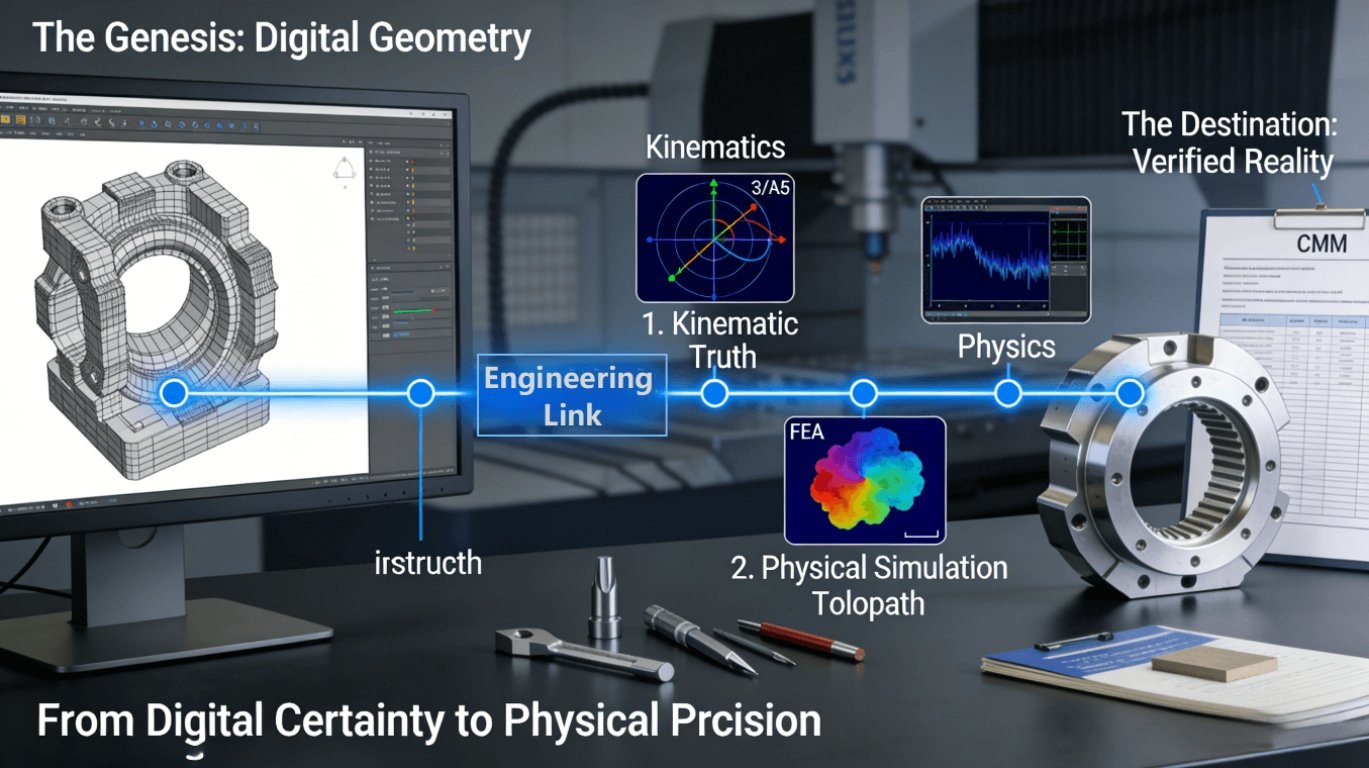
Many engineers view CNC milling as a “black box”: input a CAD model, and a machined part comes out. This understanding seeds problems during the design phase — seemingly perfect designs encounter manufacturability challenges, or suboptimal process choices are made without fully grasping the capability boundaries of different milling strategies (3-axis, 5-axis). The result is cost overruns, project delays, and even prototype failure. The root cause is the perception of CNC milling merely as “automation,” overlooking its essence as a systems engineering discipline integrating motion control, material science, tool dynamics, and thermal management. Without understanding its “first principles,” it is impossible to predict and avoid manufacturing risks or to maximize its technical potential.
This article returns to engineering fundamentals, deconstructing the first principles of CNC milling. We will move beyond machine classifications to deeply explore how coordinate axis motion dictates geometric freedom, how cutting forces and thermal management affect precision and surface integrity, and how the digital instruction chain translates design intent into physical reality. By establishing this cognitive framework, engineers can elevate Design for Manufacturing (DFM) from a passive rule check to an active, physics-based co-optimization of performance and manufacturability, fundamentally preventing costly design errors. To understand this, we begin with the most fundamental question: what is the true nature of CNC motion?
What is the True Essence of “CNC”? It’s Not Automation, It’s Coordinate Transformation.
This section delves into the core of CNC, arguing that its essence is the precise digital description and closed-loop control of multi-axis motion trajectories, a mathematical mapping from the digital to the physical world.
1. The Mathematical Engine: From Geometry to Motion Commands
At its heart, Computer Numerical Control (CNC) is a system for executing precise coordinate transformations. Consider machining a simple 2D contour. The process begins with the CAD model’s geometry. This geometry is processed by CAM (Computer-Aided Manufacturing) software, which generates a toolpath — a series of connected points in space. This path is then translated into G-code, a low-level programming language comprised of commands like G01 (linear move) and G02/G03 (circular interpolation), each specifying target coordinates (X, Y, Z) and feed rates. The CNC controller interprets this code, calculating the required movements for each servo motor to synchronize and drive the tool along the exact prescribed path. This is a deterministic, mathematical process, not a simple automation of manual actions.
2. Closed-Loop Control: The Feedback That Enables Precision
The “control” in CNC is critical. Unlike an open-loop system, a modern CNC machine uses closed-loop feedback. Encoders on each axis constantly report the actual position of the tool or table back to the controller. The controller compares this real position to the commanded position from the G-code and makes instantaneous corrections for any deviation caused by friction, cutting forces, or thermal expansion. This continuous feedback loop is what enables the micrometer-level accuracy that defines precision machining, transforming abstract coordinates into a tangible, high-fidelity part.
3. The Digital Thread Foundation
This process is the fundamental link in the digital manufacturing thread. It is the physical instantiation of digital data. Frameworks for advanced manufacturing, such as those from the National Institute of Standards and Technology (NIST), emphasize the seamless flow and interoperability of this data. CNC milling is the core enabling technology that executes this final, critical step of transforming a perfect digital twin into a precise physical asset. To deeply explore the complete knowledge system from core principles to complex applications, this comprehensive custom CNC milling services guide provides a thorough analysis from fundamentals to advanced topics.
How Does a “Cutting Path” Differ from a CAD Curve? The Physics Behind the Toolpath
This section reveals the engineering considerations behind toolpath generation, explaining that a CAM program is a physics-informed plan that manages cutting forces, tool wear, and part integrity, not just a geometric trace.
1. Beyond the Centerline: Tool Radius Compensation and Engagement
The most basic distinction is that the toolpath is not the same as the part’s edge. A CAM system must calculate the cutter centerline path by offsetting the part geometry by the tool’s radius — a process called cutter compensation. This ensures the tool’s cutting edge, not its center, contacts the desired surface. More critically, the software must manage the tool engagement angle, which is the portion of the tool in contact with the material. A 50% engagement (climb milling) is very different from a 100% slotting engagement in terms of force, heat, and potential for tool deflection or breakage.
2. Intelligent Machining Strategies: Managing Forces and Heat
Advanced toolpaths are engineered to control physics. For example, trochoidal milling is a strategy where the tool moves in a looping, circular pattern with a constant, small radial engagement. This allows for much higher feed rates and deeper axial cuts because it prevents the tool from being overwhelmed, drastically reducing cutting forces and heat generation. This is essential for machining tough materials like titanium or for maintaining the integrity of thin-walled components. Similarly, ramping or helical entry moves are used to gradually engage the tool into the material, preventing the high-impact shock of a plunge cut, which can damage the tool and the workpiece surface.
3. The Outcome: Surface Finish, Accuracy, and Tool Life
The choice of toolpath directly dictates the final part quality. A well-optimized path produces a better surface finish, holds tighter tolerances, and extends tool life. A poor path can cause chatter (violent vibration), leave visible witness lines, or create excessive heat that alters the material properties of the part. Understanding that the toolpath is the engineered bridge between the CAD model and the finished part is a core principle of CNC milling and a fundamental aspect of modern manufacturing technology.
3-Axis, 5-Axis, or More? Choosing the Right “Kinematic Chain” for Your Geometry
This section analyzes different milling technologies from a kinematics perspective, guiding the selection of the most efficient and accurate process based on a part’s geometric accessibility and feature requirements, not just perceived complexity.
1. 3-Axis Milling: The Prismatic Workhorse
A 3-axis CNC mill operates with three linear axes: X, Y, and Z. The tool moves vertically and horizontally, but its orientation relative to the workpiece is fixed (perpendicular to the table). Think of it as a highly precise, three-dimensional carving tool. It excels at machining features that are accessible from the top — pockets, slots, holes, and profiles. Its primary limitation is feature accessibility; it cannot efficiently machine the sides of a part or complex compound angles without multiple, time-consuming setups that introduce potential datum errors.
2. 5-Axis Milling: The Kinematic Problem-Solver
A 5-axis machine adds two rotational axes (typically A and C, or B and C) to the three linear ones. This allows the cutting tool to approach the workpiece from virtually any direction. This is not just about complexity; it’s about kinematic efficiency and precision. With 5-axis, the tool can maintain the optimal orientation — using the side of the tool for better cutting efficiency, keeping the tool short and rigid to reduce vibration, and accessing undercuts or deep cavities in a single setup. It transforms manufacturing from a series of 2.5D operations into true 3D volumetric machining.
3. Making the Economic and Technical Decision
The choice isn’t “3-axis for simple, 5-axis for complex.” It’s a technical and economic calculation. A part with a few angled holes might be best done on a 3-axis mill with a tilt rotary table (a 3+2 setup). A sculpted aerodynamic surface requires continuous 5-axis simultaneous motion. The correct choice minimizes setups, improves accuracy by maintaining a single datum, and often reduces total cost despite a higher machine hourly rate. Therefore, translating a kinematics-based process choice into a part with exceptional precision and surface integrity requires partnering with an experienced CNC precision milling manufacturer.
Precision vs. Cost: What’s the Real Trade-off in Tolerances and Surface Finish?
This section provides a quantitative engineering analysis of the relationship between specified precision and manufacturing cost, guiding designers to apply tolerances and finishes based on functional necessity.
- The Exponential Cost of Linear Precision: The cost-tolerance relationship is not linear; it’s exponential. Holding a tolerance of ±0.05mm is standard for many milling operations. Tightening it to ±0.025mm may increase cost by 30-50% due to slower speeds, finer finishing passes, and potentially specialized tooling. Demanding ±0.010mm or tighter can double or triple the cost, as it now requires a high-precision machine in a temperature-controlled environment, meticulous tool and workpiece fixturing, in-process measurement, and 100% inspection with metrology-grade equipment.
- The Drivers of the Cost Curve: Several factors drive this cost curve. Machine capability and stability are paramount; not all machines can physically achieve micron-level accuracy. Thermal management becomes critical, as heat from the machine, tool, and environment can cause expansion exceeding the tolerance band. Measurement and verification shift from sample checks to comprehensive, time-consuming CMM inspection for every feature. The pursuit of ultra-fine surface finish follows a similar curve, requiring specialized tooling, perfect tool condition, and extremely fine stepovers that drastically increase machining time.
- Designing with the Cost Curve in Mind: The solution is functional tolerance analysis. For every dimension, ask: “What is the explicit functional requirement?” A bearing bore needs a tight size and roundness tolerance; a non-mating clearance pocket does not. By applying a tolerance hierarchy — tight for critical interfaces, standard for most features, and loose for non-critical areas — you design for performance and cost-effectiveness. In regulated industries, systems like those mandated by IATF 16949 provide the methodological framework (through SPC and MSA) to ensure that specified tight tolerances are not just achieved once, but are consistently and verifiably maintained in production.
The Partner Selection Checklist: Does Your Manufacturer “Think” in Physics or Just in Drawings?
This final section provides a practical checklist for evaluating a potential manufacturing partner based on their depth of engineering understanding and systematic approach, rather than just their ability to read a blueprint.
1. Probing for Engineering Depth, Not Just Compliance
Move beyond “Can you make this?” Ask: “Walk us through your approach to machining this thin-walled feature. How do you select the tool, toolpath strategy, and parameters to prevent chatter and deformation?” A vendor will quote the print; a partner will discuss dynamic stiffness, harmonic damping, and cutting force simulation. Listen for evidence that they model the physics of the cut, not just the geometry.
2. Evaluating Their Systematic Problem-Solving Framework
Inquire about their response to non-conformances. Ask to see an example of a corrective action report (like an 8D). Does the root cause analysis point to a specific physical variable (e.g., “carbide grade unsuitable for interrupted cut in 17-4PH”)? Are the corrective actions systemic, like updating the control plan? This reveals a culture of preventive engineering and continuous improvement, not just firefighting.
3. Demanding Evidence of Process Mastery and Data-Driven Culture
Request tangible proof of capability. Ask for: “Historical Statistical Process Control (SPC) charts for a critical dimension on a past, similar job, demonstrating a Cpk > 1.33.” Also, ask about their investment in technology and training — are they exploring digital twin simulation or advanced tool coatings? A partner that invests in deepening their own engineering solutions and can provide data-backed evidence of their process stability is a strategic asset for driving industrial innovation. This aligns with industry methodologies that value a systematic, knowledge-based approach to manufacturing.
Conclusion
As industrial manufacturing advances toward greater intelligence and precision, understanding CNC milling must penetrate the veneer of “automation” and return to its essence as a precision engineering discipline. By mastering its first principles — coordinate transformation, toolpath physics, kinematic selection, and the economics of precision — engineers and decision-makers can engage with manufacturing partners in a shared scientific language. This transforms product development from experience-dependent trial and error into predictive, collaborative innovation, locking in quality, cost, and delivery certainty at the source.
FAQs
Q: What is the most common misconception about CNC milling?
A: The most common misconception is that it is simply “automated cutting.” In reality, it’s a deeply engineered process whose success depends on understanding material behavior, toolpath physics, thermal management, and machine kinematics to accurately and cost-effectively translate a digital design into a physical part.
Q: How do I decide between 3-axis and 5-axis milling for a part with some angled features?
A: The decision hinges on feature accessibility and total cost. For a few simple angles, 3-axis with a secondary setup may be cheaper. For multiple complex angles, deep cavities, or when optimal tool orientation is critical for finish/accuracy, 5-axis in a single setup often provides better results and a lower total cost by eliminating fixtures and handling.
Q: What does a “tight tolerance” realistically mean in CNC milling, and how is it measured?
A: In precision milling, a “tight tolerance” typically means ±0.025mm or less. It is verified using high-precision metrology like Coordinate Measuring Machines (CMMs) that compare the part to its CAD model. Achieving this consistently requires control over machine calibration, tooling, environment, and programming.
Q: Can you achieve a high-quality surface finish directly from the CNC mill, or is post-processing always needed?
A: A very good surface finish (Ra 0.8 μm or better) can be achieved directly with fine stepovers, sharp tools, and optimized parameters. For an optical mirror polish or specific textures, secondary processing is needed. The “as-milled” finish is often sufficient for functional and many aesthetic applications.
Q: How does the choice of cutting tool material (like carbide vs. diamond) affect the milling process?
A: The tool material dictates cutting speed, tool life, and machinable materials. Carbide is versatile for most metals and plastics. Diamond-coated tools are essential for abrasive composites or high-silicon aluminum, offering vastly longer life. The choice directly impacts machining time, part quality, and total job cost.
Author Bio
This article springs from ongoing inquiry into the fundamental engineering principles that connect design theory to production practice within the precision manufacturing sector. As a certified manufacturing partner (ISO 9001, IATF 16949, AS9100D), the team at LS Manufacturing is dedicated to transforming profound engineering understanding into a deterministic advantage for clients’ products. Looking to optimize your critical component design and manufacture at the “first principles” level? Contact their engineering team for specialized insight.



Everything You Need to Know About Drain Cleaning

Hydro Jetting Safety Tips and Techniques Used by Experienced Plumbing Professionals

The Complete Guide to Professional Packing for a Safe and Stress-Free Move
